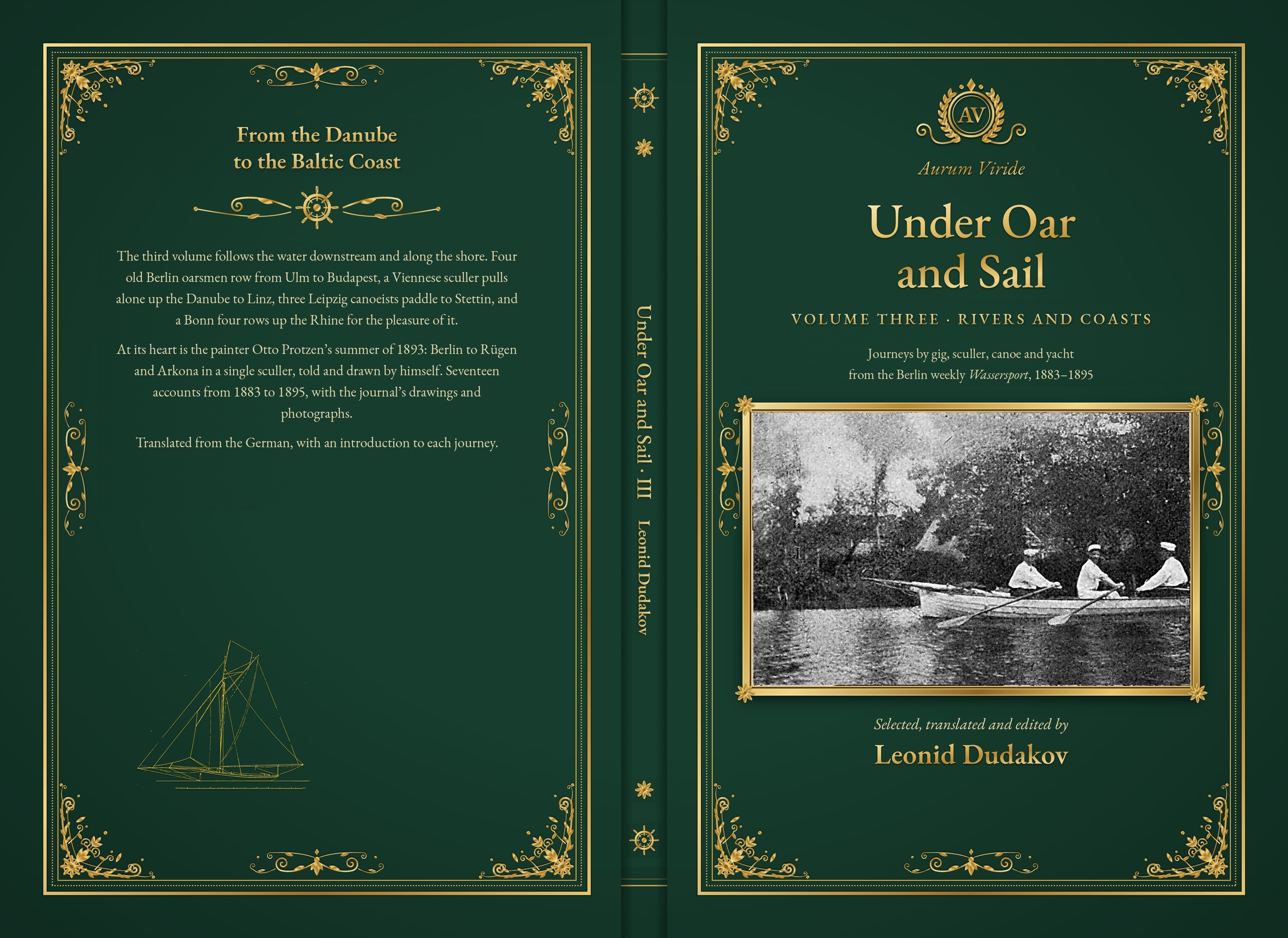
Under Oar and Sail

Volume Three · Rivers and Coasts

Journeys by gig, sculler, canoe and yacht from the Berlin weekly Wassersport, 1883–1895

Selected, translated and edited by Leonid Dudakov

Language
English
Pages
202
Format
6 × 9 in
Paperback · E-book

From the Danube to the Baltic Coast

The third volume follows the water downstream and along the shore. Four old Berlin oarsmen row from Ulm to Budapest, a Viennese sculler pulls alone up the Danube to Linz, three Leipzig canoeists paddle to Stettin, and a Bonn four rows up the Rhine for the pleasure of it.

At its heart is the painter Otto Protzen’s summer of 1893: Berlin to Rügen and Arkona in a single sculler, told and drawn by himself. Seventeen accounts from 1883 to 1895, with the journal’s drawings and photographs.

Translated from the German, with an introduction to each journey.

This book in other languages: Deutsch · Русский

Look inside

  • Look inside 1
  • Look inside 2
  • Look inside 3

Preface

The first two volumes of this series divided the journeys in Wassersport by the way the boats were driven: under oar on inland water, under sail at sea. This third volume gathers what the first two had no room for, and it follows the water rather than the rig. Most of its journeys go down a river or along a coast, and many of them go from one to the other: from Berlin to the Baltic in a single sculler, from the Spreewald to the open sea off Usedom in two canoes, from Einbeck down the Leine to Bremen in a canoe.

The book follows the journal roughly in the order the journeys were made, from 1883 to 1895. It begins with two racing boats taken out to sea for a day and with a scientific expedition, half in jest, to a coral island off Madagascar. Then come the great rivers. Four old members of a Berlin club row from Ulm to Budapest, and a Viennese sculler, alone, rows the same Danube upstream to Linz and comes home in one day. Three Alsatians take a pair down the Rhine from Strassburg, and two Berlin oarsmen photograph the Spreewald. Three middle-aged canoeists from Leipzig paddle to Stettin, and two members of the Berliner Ruder-Club defend the Rob Roy canoe against its critics. Four sailing chapters follow: a squadron of tiny English yawls in Holland, the Berlin students’ cutter on its fourth Baltic voyage, two naval officers on holiday, and a Stettin cutter round the island of Usedom. The last part belongs to the 1890s. It holds the longest journey in the book, the painter Otto Protzen’s summer of 1893 in his sculler Elfe, with his own drawings. It also holds a canoe on the wild upper Leine, two Berlin canoeists who let the Danube carry them from Ulm to Vienna in ten days, a dinghy and a sculler in the Mecklenburg lakes, and a Bonn four that rowed up the Rhine against the current for the pleasure of it.

The rules of choice are those of the earlier volumes. Only finished accounts in which something happens have been included; serials broken off before the end have been left out, however promising. The texts are given in full. The writers were oarsmen, canoeists and yachtsmen, a painter, a technician, students; they kept their clock times and distances carefully, and these are kept here. Every figure that matters has been checked against the page image of the journal. Their rivers have since been straightened, dammed and bridged, and many of their towns now have other names in other countries. The water is still there.

— Leonid Dudakov

Read an excerpt

The opening pages of a chapter.

CHAPTER ONE

Racing Boats at Sea

A four from Rotterdam to Scheveningen by the North Sea, September 1883, and a four from Trieste to Parenzo and back, August 1890 — Wassersport, 1883 and 1890

A racing boat is built for flat water, and nobody in the 1880s recommended taking one to sea. These two short accounts are by German oarsmen living abroad who did it anyway, each on a single fine day.

The first crew belonged to the German Gymnastic and Rowing Club of Rotterdam. They took their narrow four Falke down the Maas to the Hook of Holland, saw a Dutch pair set off along the coast for Scheveningen, and followed it out past the pier-head. They landed through the surf at Scheveningen and carried the eleven-metre boat over the dunes to the canal. The second crew rowed for the gymnastic club Eintracht of Trieste. They took a four with fixed rowlocks from Trieste down the Istrian coast to Parenzo and back in thirty-two hours, nearly fifteen of them at the oars, by night as much as by day. Their timetable is printed after the account. — Leonid Dudakov

In a racing boat on the North Sea

Of the many and interesting rowing excursions which the Deutscher Turn- und Ruder-Verein in Rotterdam has made this season, perhaps the finest and most unusual was carried out on Sunday, 16 September, by five members in the four-oared racing boat with fixed rowlocks Falke. Let one of the party tell it himself.

We had long planned a trip to the Hook of Holland, but had been kept from carrying out our plan several times already by bad weather or other obstacles. On Sunday, 16 September, we decided to try once more; and since the ebb was running until about eleven that morning, if we started at eight we could still reach our goal with the stream. Having gathered at the boathouse at the appointed time and stowed the provisions we had brought, with rowing jackets, sweaters and so on, well in our Falke, we rowed out of the harbour in the best of spirits in spite of the thick fog, where the fog signals of the steamers warned us to the greatest caution. As we could hardly make out objects within a boat’s length, it was no wonder that near Schiedam we went astray into a bay of the river, which happened to us once more, for all our care, before we reached Vlaardingen. Here we stopped to wait for better weather, which soon came, so that after half an hour we could go on in the brightest sunshine, and about eleven reached Maassluis, constantly treated to great waves by passing sea-going steamers, which had likewise waited for the clear weather.

Meanwhile the flood had made, and we had to work against the stream for another hour until at last, about twelve, the goal of our trip, the village of Hook of Holland, came in sight. There we left our Falke in the care of a pilot stationed there, to climb the lighthouse, to which a pier some two kilometres long leads out. As the rising tide was already washing over part of it, however, it was no longer advisable to visit the lighthouse, so we gave up that plan and admired from the pier the North Sea, shining today in a splendid dark blue. But already the breakers were rolling up close to where we stood, and as we walked slowly back along the pier we noticed three gentlemen of the rowing club De Maas, who had left Rotterdam on Saturday evening and were now busy getting their pair Stella afloat. After greetings on both sides the gentlemen told us that they meant to row by sea to the watering place of Scheveningen, about four hours away; we waved our hats in farewell, which the Stella’s crew answered with “oars up”, and the boat went on her way along the pier towards the sea.

From the signal station on the top of the dunes we now followed through a telescope the progress of the rather high-built boat, which gradually vanished in the direction of Scheveningen. She had gone very well through the waves, and we considered whether we could venture it too in our crank and rather flat-built racing boat. We had already rowed four hours, and, so as not to lose the help of the flood, would have to get into the boat again at once and pull hard for another two and a half hours to reach Scheveningen. The wind was blowing from the sea and so was as favourable to our undertaking as it could possibly be, and we therefore decided to go to sea too. Arriving at our boat’s landing place, we asked the pilot, who knew the sea and the weather, for his opinion, and he told us that we might wait a long time before circumstances would combine so favourably again; that there would be no change in the weather during the day he believed he could vouch for — but, he added at the end of his advice, “I wouldn’t care to row along in that little boat myself.”

Contents

  1. Preface
  2. Racing Boats at Sea
  3. A Scientific Expedition to Plum Island
  4. From Ulm to Budapest
  5. Upstream from Vienna to Linz
  6. Down the Rhine from Strassburg
  7. A Trip to the Spreewald
  8. By Canoe from Leipzig to Stettin
  9. From the Spreewald to the Baltic in Rob Roy Canoes
  10. A Sailing Trip through Holland
  11. The Students’ Cutter Again
  12. Two Naval Officers on Holiday
  13. Round Usedom
  14. To the Baltic in a Single Sculler
  15. By Canoe from Einbeck to Bremen
  16. Down the Danube by Paddle Boat
  17. Magdeburg, Neustrelitz, Potsdam
  18. Against the Stream