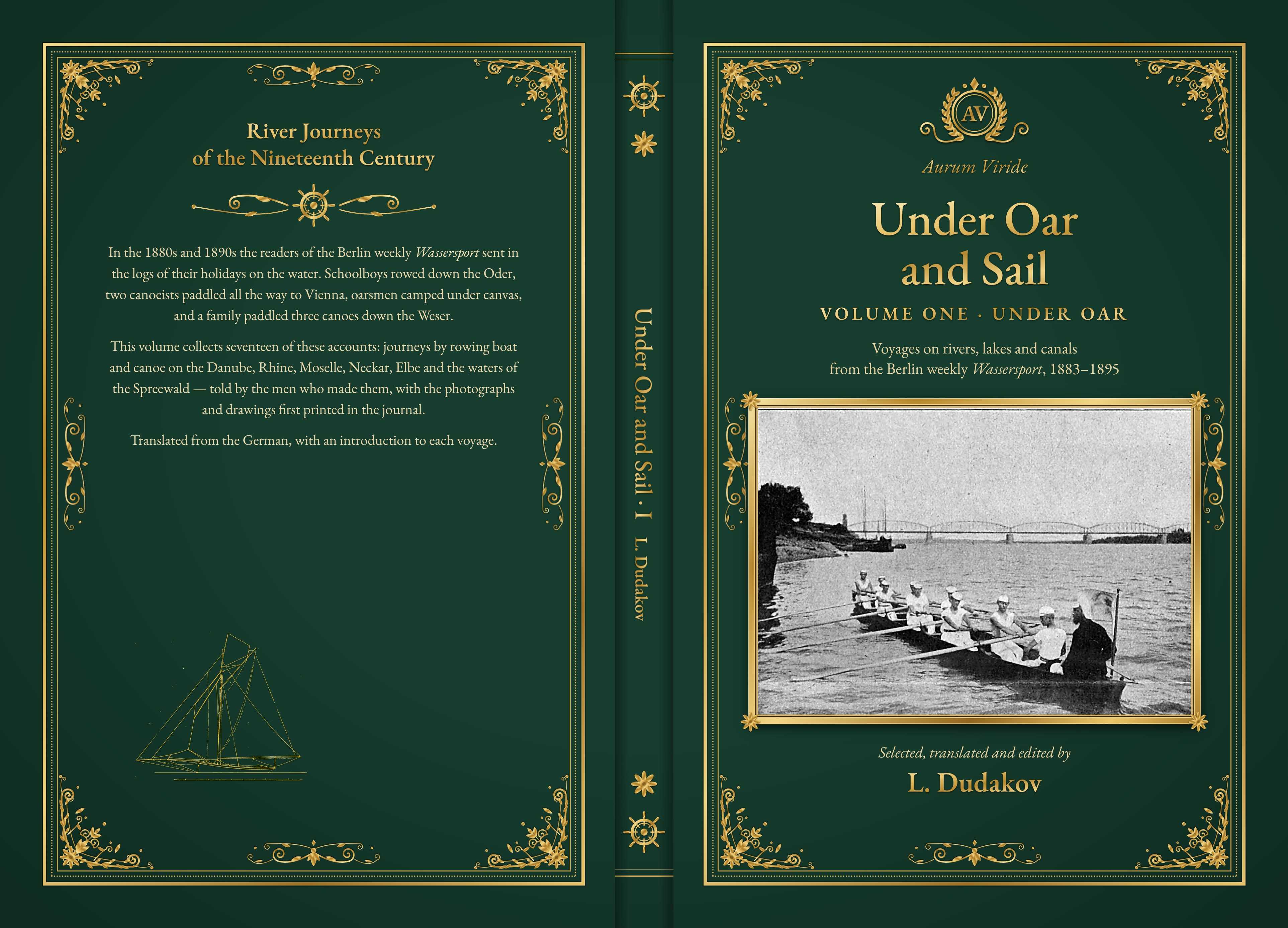
Under Oar and Sail

Under Oar and Sail

Volume One · Under Oar

Voyages on rivers, lakes and canals from the Berlin weekly Wassersport, 1883–1895

Selected, translated and edited by L. Dudakov

Language
English
Pages
260
Format
6 × 9 in
Paperback · E-book

River Journeys of the Nineteenth Century

In the 1880s and 1890s the readers of the Berlin weekly Wassersport sent in the logs of their holidays on the water. Schoolboys rowed down the Oder, two canoeists paddled all the way to Vienna, oarsmen camped under canvas, and a family paddled three canoes down the Weser.

This volume collects seventeen of these accounts: journeys by rowing boat and canoe on the Danube, Rhine, Moselle, Neckar, Elbe and the waters of the Spreewald — told by the men who made them, with the photographs and drawings first printed in the journal.

Translated from the German, with an introduction to each voyage.

Coming soon

This book in other languages: Deutsch · Русский

Look inside

  • Look inside 1
  • Look inside 2
  • Look inside 3

Preface

Every week from 1883 to 1895 the Berlin journal Wassersport printed race results, club news and arguments about rules. Every summer and autumn, among these, it printed letters and serials from readers who had simply gone somewhere by boat. A schoolmaster took his pupils down the Oder in an eight. A student paddled from the source of the Danube home to Berlin. Clerks and engineers rowed their racing boats to the Baltic for a holiday. A doctor took his wife and a heavy friend down the Weser in three second-hand English canoes. These accounts were written by amateurs for other amateurs, usually within a few weeks of coming home. They are the most personal pages the journal ever printed, and this book collects them.

This first volume contains the voyages made under oar and paddle: on the rivers, lakes and canals of Germany and, in two cases, beyond. The second volume, Under Sail, contains the voyages made under sail and at sea. The chapters follow the order of the voyages themselves, from 1881 to 1893. Two accounts from abroad come next, and the book closes with the longest and youngest voyage of all, a schoolboys’ eight that rowed round two provinces of Prussia in 1895. Where several short accounts belong together — the Spreewald, the Rhine, a single Berlin season — they share a chapter.

The choice has been strict. Only accounts in which something actually happens, and which tell it well, have been included. Many more were printed: lists of stations and times, polite thanks to hospitable clubs, and translations from English magazines. The texts chosen are given in full, apart from a few digressions. These are mostly days spent ashore: a walk in the Eifel, sightseeing and hospitality in the towns along the way, and a tourist's journey to the North Cape. Each such omission is marked by a bracketed note where it occurs. Some serials were never finished, or survive only in part in the copies of the journal that have come down to us. Where an instalment is missing, the chapter says so; nothing has been supplied in its place.

The writers were oarsmen and canoeists, not authors, and their German is often hurried and sometimes careless. I have kept their tone, their jokes and their names for places and boats. Where the scan of a page could not be read with certainty it was checked against the page image, and where a writer was plainly wrong about a fact a footnote says so. The scenery they describe has mostly changed past recognition: the rivers are canalised, the weirs rebuilt, the ferry houses and the inns gone. What has not changed is the experience of these pages: a wet seat, a head wind on a long reach, an unexpected kindness at a strange landing stage, and the lights of a town coming into view after dark.

— L. Dudakov

Read an excerpt

The opening pages of a chapter.

CHAPTER ONE

Schoolboys on the Oder

An eight-oar from Ohlau to Stettin and the sea, 1881 — Wassersport, 1883

In the summer of 1881 a schoolmaster in the small Silesian town of Ohlau took ten of his senior pupils, his own son among them, down the Oder in an eight-oared gig to Stettin, some 450 kilometres of river, and then out on to the Baltic. Rowing was barely known in German schools; the parents were warned on all sides that the boys would collapse after a few days and come home by train. They did not. Dr C. Lampe wrote the voyage up for the Schlesische Zeitung and, two years later, at greater length for Wassersport, in the hope of persuading other headmasters to let their boys loose on the rivers.

His account is the oldest long river journey in the journal and sets the tone for many that followed: the boat, the kit and the rations described with care; a strict little discipline on board; and a teacher's delight in the towns, battlefields and poets along the way. A second Ohlau voyage over the same water, made three years later, follows in the next chapter. The section headings are ours. — L. Dudakov

I. The Ohlau Gymnasium Rowing Club

I have ventured to lay the following account of a river journey through Middle and Lower Silesia, Brandenburg and Pomerania before the readers of Wassersport in the confidence that among them there will be no lack of energetic men who think the idea of opening the sport of rowing to the older boys of our grammar schools worth their notice and their support. If anywhere, it was among the friends of German rowing that I could hope to find allies in spreading it in our gymnasia and modern schools. I was thinking particularly of those gentlemen who, as members of state or municipal bodies, have some connection with our system of education. Should the description of my voyage awaken the wish to see such undertakings become common in our higher schools, it will have served its essential purpose.

In the spring of 1880 I founded a rowing club for the upper forms of our gymnasium. Within a short time it had more than thirty members, and the nearby Oder soon showed a lively traffic. To the practice of swimming was added the new and still unfamiliar spectacle of rowing. After a four-oared gig, which we called Wega, we had a handsome eight built, and we set the three stars of Orion’s belt in her flag and the name of that fine constellation on her bow. The classical superstition of the senior boys later disapproved of this, for whenever Orion took part in a long trip there was seldom any lack of storm and foul weather, the works of the ancient nimbosus Orion. Towards the end of the summer the two gigs were joined by a pair-oared outrigger, the Blitz, the gift of a senior boy named Kohlisch, who then left to serve his year in the Uhlans. Members owned eight Greenlanders privately. The first boat of this kind was brought here by V. Szarbinowski, now a lieutenant in the 64th Infantry Regiment, Prince Frederick Charles. He had probably paddled one about the Oder at Breslau as a boy, and nothing was further from my mind than the thought that at my age and at a weight of 174 pounds I could still learn to handle so small a boat safely; but it went better than I had expected, and I do not regret having had one built for myself.

When the high water of 1880 came down, a rumour went round the town: “Well, one of the rowing club has drowned already!” Many a superior wisdom heard this with the satisfaction that only the awareness of having foreseen a misfortune clearly and certainly can give. The fact, however, was that we had saved a life. A young chemist had boasted that he would swim across the swollen Oder. In the middle of the river his strength failed him; perhaps, too, this otherwise brave and nimble gymnast was a stranger to the state into which the close sight of a broad mass of water rushing past can throw a man, and which might be called horizontal giddiness. At the endangered swimmer’s cry for help our Wega, which happened to be returning from a practice row, hurried up and brought him ashore. Later, when our daredevil had recovered his former humour, he delighted me with the cheeky gasconade that it was not the Wega that had saved him, but he who had saved the Wega.

Coming soon

Contents

  1. Preface